
Process Safety Consultancy
Ensuring safer operations through expert Process Safety Consultancy—NJVJ Overseas delivers proven strategies, compliance solutions, and proactive risk management to protect people, assets, and the environment across global industrial operations.
Process Safety Consultancy
Process Safety Consultancy is dedicated to systematically identifying, assessing, and controlling hazards in industrial processes to prevent accidents, safeguard personnel, protect the environment, and ensure operational continuity. It integrates advanced engineering methodologies with internationally recognized standards such as OSHA’s Process Safety Management (29 CFR 1910.119), CCPS Risk-Based Process Safety (RBPS) guidelines, API, IEC and NFPA fire and explosion protection standards. By embedding safety principles across the entire lifecycle—from conceptual design through operation to decommissioning—our approach ensures the safe handling of hazardous materials, equipment, and systems. This comprehensive alignment with global best practices minimizes process risks, strengthens regulatory compliance, and delivers resilient, high-reliability operations.
At NJVJ Overseas, we deliver tailored Process Safety Consultancy services designed to meet the unique needs of global industries. Our experienced engineers and compliance experts partner with clients to implement robust safety management systems covering hazard identification, audits, and emergency response planning. Built on proactive risk management and continuous monitoring, our approach ensures regulatory compliance without disrupting productivity. With global experience and deep industry knowledge, we are committed to zero-incident operations, sustainable performance, and long-term operational excellence—making us a trusted partner in safe and resilient industrial operations.
We provide comprehensive support in implementing all elements of Process Safety Management (PSM) through procedure development, structured methodologies, comprehensive checklists, mentoring, and hands-on training. Our approach builds capability across every level of your organization—from corporate leadership to frontline personnel—ensuring PSM is effectively embedded within your own systems. By aligning with OSHA PSM standards and CCPS guidelines, we equip your staff with the knowledge, tools, and confidence to manage hazards, strengthen compliance, and sustain a culture of safety excellence long after our engagement.
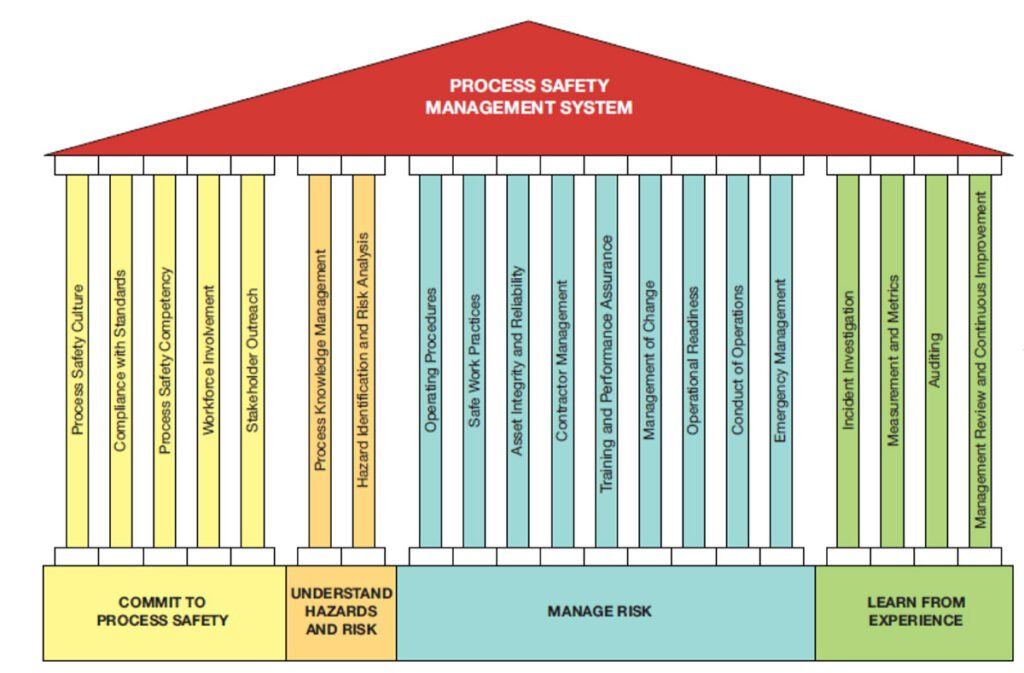
Process Safety Management
Project Initiation & Feasibility
- Preliminary hazard identification (Pre-HAZID)
- Regulatory applicability review
- Process safety philosophy
Conceptual Design
- High-level consequence modeling
- Inherent safety review
- Preliminary siting & layout safety review
Front-End Engineering Design (FEED)
- HAZID
- HAZOP
- LOPA (Layer of Protection Analysis)
- SIL Determination
- Fire & explosion risk analysis (FERA)
- Toxic release dispersion study
- Occupied building risk assessment (OBRA)
- Escape, Evacuation & Rescue Analysis (EERA)
- Emergency systems survivability assessment (ESSA)
- Relief & flare system design
- Hazardous area classification
Detailed Engineering
- Review of vendor packages for safety compliance
- Safety instrumented system (SIS) design
- Hazardous materials compatibility review
- Active fire protection (AFP) Firewater system hydraulics & layout
- Passive fire protection (PFP) design
Construction & Pre-Commissioning
- Construction safety reviews
- Pre-startup safety review (PSSR)
Operations & Post-Startup
- Mechanical integrity program setup
- Management of change (MOC) process
- Incident investigation procedure
- Process safety performance monitoring
General EHS / PSM Procedures
- EHS Resource Needs & Staffing Plan
- EHS Goals & Objectives Procedure
- Regulatory Compliance Tracking Procedure
- Management of Change (MOC) Procedure
- Incident Reporting Procedure
- Incident Investigation & Root Cause Analysis Procedure
- Internal Communication Procedure
- External Stakeholder Communication Procedure
- Contractor Safety Management Procedure
- Document & Record Control Procedure
- PSM/EHS Compliance Audit Procedure
- EHS Performance Monitoring & Metrics Procedure
- Management Review Procedure
- Process Hazard Analysis (PHA / HAZOP) Procedure
- Spill Prevention, Control & Countermeasure (SPCC) / Oil Spill Contingency Procedure
- Safety Observation / Behavior-Based Safety Procedure
- EHS Training & Competency Procedure
- EHS Leadership & Accountability Procedure
- EHS Performance & Recognition Procedure
- Records Retention Procedure
- Organizational / Personnel Change Management Procedure
- Near-Miss Reporting & Analysis Procedure
- Project-Specific EHS Plan Procedure
- Pre-Startup Safety Review (PSSR) Procedure
Safety Procedures (Task-Oriented / OSHA-Aligned)
- Ladders & Portable Equipment Safety Procedure
- Scaffolding Safety Procedure
- Manual Material Handling & Ergonomics Procedure
- Permit-to-Work (PTW) System
- Respiratory Protection Program (incl. SCBA/Breathing Apparatus Use)
- Flange Bolting & Mechanical Joint Integrity Procedure
- Confined Space Entry Procedure (OSHA 1910.146)
- Pressure Testing & Leak Testing Procedure
- Pneumatic Tools & Equipment Safety Procedure
- Personal Protective Equipment (PPE) Procedure
- High-Pressure Water Jetting & Surface Prep Procedure
- Abrasive Wheels & Grinding Safety Procedure
- Mobile Equipment & Vehicle Safety Procedure
- Portable Power Tools Safety Procedure
- Line Break / Opening of Piping Systems Procedure
- Defensive Driving & Fleet Safety Procedure
- Pipeline Clamping & Integrity Repair Procedure
- Job Hazard Analysis (JHA) Procedure
- Safety Instrumented System (SIS) Bypass/Override Control Procedure
- Hot Work Procedure (Welding, Cutting, Burning)
- Lockout/Tagout (LOTO) Electrical Safety Procedure
- Demolition & Decommissioning Work Procedure
- Explosive Materials Handling Procedure
- Excavation & Trenching Safety Procedure
- Electrical Safe Work Practices Procedure (NFPA 70E)
- Electrical Classification (Hazardous Area Classification Updating Procedure)
Environmental Procedures
- Environmental Impact Review Procedure
- Chemical Spill Response Procedure
- Wastewater & Effluent Management Procedure
- Hazardous Materials Transportation & Storage Procedure
- Waste Management (RCRA) Procedure
- Soil / Pit Closure & Remediation Procedure
Health & Industrial Hygiene Procedures
- Hydrogen Sulfide (H₂S) Safety Program
- Portable Gas Detector Calibration Procedure
- Atmospheric Gas Testing Procedure
- Occupational Health & First Aid Procedure
- Asbestos Management & Abatement Procedure

Key Elements of
Process Safety
- Process Safety Philosophy / Basis of Safety Design – Defines the overarching safety principles, design assumptions, and protective measures to be embedded across the facility lifecycle.
- Regulatory Applicability & Compliance Register – Documents all applicable OSHA, CCPS, NFPA, API, IEC, and local codes to ensure designs meet mandatory and best-practice standards.
- Inherently Safer Design (ISD) Review – Evaluates opportunities to eliminate or minimize hazards through design choices rather than relying solely on add-on controls.
- Preliminary Hazard Identification (Pre-HAZID) Report – Provides an early-stage review of potential risks to guide safer project layouts, siting, and concept selection.
- Formal HAZID Study Report – Identifies hazards systematically and recommends design safeguards to prevent or mitigate risks.
- Process Hazard Analysis (PHA) – HAZOP Report – Analyzes deviations in process parameters to uncover causes, consequences, and required safeguards for operability and safety.
- Layer of Protection Analysis (LOPA) Report – Evaluates the adequacy of safeguards by quantifying risk reduction and identifying needs for additional layers of protection.
- SIL (Safety Integrity Level) Determination & Safety Requirements Specification (SRS) – Defines reliability requirements for safety instrumented functions (SIFs) and specifies testing intervals to achieve targeted risk reduction.
- Cause & Effect (C&E) Diagrams – Maps safety functions and interlocks, ensuring automatic responses to abnormal process conditions are clearly defined.
- Fire & Explosion Risk Analysis (FERA) Report – Quantifies fire, explosion, and blast scenarios to guide fire protection system design and safe facility layout.
- Toxic Release Dispersion Study Report – Models the behavior and impact zones of toxic chemical releases to support siting and emergency planning.
- Occupied Building Risk Assessment (OBRA) – Evaluates risks to personnel in control rooms and occupied facilities, recommending siting and strengthening measures.
- Escape, Evacuation & Rescue Analysis (EERA) – Ensures workers can safely evacuate or be rescued under worst-case emergency scenarios.
- Emergency Systems Survivability Assessment (ESSA) – Confirms critical systems (e.g., firewater, power supply) remain functional during major incidents.
- Hazardous Area Classification (HAC) Drawings & Report – Defines zoning for electrical and instrumentation installations to minimize ignition risks.
- Relief & Flare System Design Report – Sizes relief valves and flare systems in accordance with API standards to manage overpressure safely.
- Flare Radiation & Dispersion Analysis – Assesses flare stack performance, radiation levels, and dispersion to ensure compliance and personnel safety.
- Safety Instrumented System (SIS) Design Documentation – Provides detailed design, logic, and proof-testing requirements for safety-critical instrumented functions.
- Firewater Demand Calculations & Hydraulic Network Analysis – Ensures firewater systems are capable of meeting emergency firefighting requirements.
- Active Fire Protection (AFP) System Layouts – Defines detailed layouts for sprinklers, deluge systems, and fire monitors to ensure adequate coverage.
- Passive Fire Protection (PFP) Specifications – Prescribes coatings, fireproofing, and thermal barriers to protect equipment and structures during fires.
- Hazardous Materials Compatibility Review – Confirms storage and handling systems prevent unsafe reactions between chemicals.
- Human Factors Engineering (HFE) / Ergonomic Review – Ensures operator interfaces, access ways, and controls are designed for safety and usability.
- Pre-Startup Safety Review (PSSR) Checklist & Report – Verifies that systems, procedures, and safeguards are in place before introducing hazardous materials.
- Construction Safety Review (CSR) Documentation – Confirms that construction practices, temporary systems, and sequencing align with process safety requirements.
- Mechanical Integrity Program (Inspection, Testing & Maintenance Plan) – Establishes inspection and preventive maintenance schedules to preserve equipment integrity.
- Management of Change (MOC) Procedure & Templates – Provides a systematic approach for evaluating and approving changes to prevent new hazards.
- Operating Procedures – Defines safe methods for normal, startup, shutdown, and emergency operations to guide operators effectively.
- Permit-to-Work (PTW) Procedures – Controls high-risk tasks such as hot work, confined space entry, and electrical work to prevent accidents.
- Incident Investigation Procedure & Root Cause Analysis (RCA) Framework – Establishes structured methods for investigating events, identifying causes, and preventing recurrence.
- Emergency Response Plan (ERP) and Drill Reports – Outlines coordinated response actions, supported by drills to validate preparedness.
- Process Safety Performance Indicators (Leading & Lagging KPIs) – Tracks performance metrics to measure safety effectiveness and identify trends.
- Compliance Audit Protocols & Reports – Provides structured reviews to verify ongoing adherence to OSHA, CCPS, and NFPA standards.
- Training & Competency Matrices for PSM Elements – Maps required skills, tracks training, and ensures personnel competency in all process safety areas.
- Ignition source assessment: Evaluate and control potential ignition sources to minimize fire and explosion risks in line with OSHA, CCPS, and NFPA standards.
- Fire and building code services: Ensure facility design, construction, and operations comply with international fire protection and building safety codes for regulatory approval and safe occupancy.
- Electrostatic Hazard Assessment – Identify and mitigate static electricity risks to prevent ignition, fires, and explosions in line with OSHA, CCPS, and NFPA guidance.
- Dust Hazard Analysis (DHA) – Evaluate combustible dust risks, ignition potential, and explosion consequences to ensure compliance with NFPA 652/654 and protect facility integrity.
Why You Choose Us For
Process Safety Consultancy
Choosing NJVJ Overseas means partnering with safety experts dedicated to protecting your people, assets, and reputation. We deliver innovative, compliant, and practical safety solutions that reduce operational risks while enhancing long-term reliability and global competitiveness.
Global Safety Expertise
Our team applies international best practices and proven safety frameworks tailored to your industry’s operational and compliance requirements.
Customized Risk Solutions
We develop safety strategies designed to address your specific processes, hazards, and regulatory obligations, ensuring optimal protection.
Compliance Assurance
Continuous monitoring and guidance help your operations stay aligned with evolving safety laws, industry standards, and environmental regulations.
End-to-End Support
From hazard identification to training and audits, we provide comprehensive support for safe, compliant, and efficient industrial operations.
Ready To Work Together?
Join hands with NJVJ for innovative, tailored, and result-driven solutions that ensure global success across Engineering, Process Safety Management, Civil & Structural, Human Resources and IT, domains.

Quick Links
Contact Details
- 295, block-D, Gali no- 55, Mahavir enclave, Part-3 , Uttam Nagar Delhi, India- 110059
- H-001, Mayuresh Park, Lake Road, Bhandup- West, Mumbai , Maharashtra, India- 400078
Inquiry Now